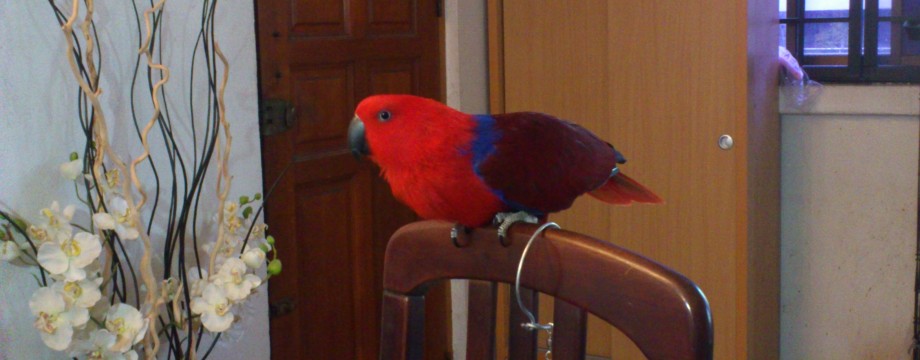
You’ve probably read about Eclectus on the Internet before you found my site. Are they suitable for Singapore homes?
Because 99% of us live in an apartment. So is an ekkie suitable to keep in our cramped space?
Presuming your bird has been raised properly (ie no forced weaning, appropriate feed and sleep schedules) these are the periods when it will be the loudest:
- 5-7 months old
- 1.2-1.5 years old
- Hormonal when mature
- First egg/babies
- Night frights
Weaning is arguably the loudest time of keeping an Eclectus. This period will pass over the course of 1-3 months. There is no cure for this as it is nature intended, but to have patience and earplugs. (If you cannot tolerate this then you should not get a large macaw as they also call frequently as babies. I have friends who had to rehome theirs!)
During weaning it is important not to accidentally let the bird slip into calling for attention! Resist the temptation to run to them whenever they cry and most importantly – set a schedule of when to handle and when not to so the bird understands resting and cage time!! A youngster I knew was so well loved that unfortunately he was loved into habitual screaming for attention and eventually given up. Many hearts were broken, please save yours.
Eclectus learn to talk best around 5 months old so they will be very chatty during that period. So if your bird hears some abominable sounds, it’s going to mimic that. My SI male picked up some Green-cheeked conures’ screaming in 2 days. The youngest I’ve seen talking is a purebred Vos female at 3 months old.
At 1.2-1.5 years of age hormones start to show up especially for females. This is worse if you have a pair living together, she will start chasing the male around and panicking – he screams while she growls.
When mature, both develop their thunderous crow-like screams. I have found in my experience that females do not scream randomly under a certain set of circumstances (ie have a nestbox) unless there are strangers or naturally if something excites them but for the males they tend to go off without a reason. Alpha males will scream if they see another male flapping or even nearby, when they are hormonal and unable to release frustration (females MAY scream also if they are nesty without a box).
I also observe that with the laying of their first clutch, regardless of whether there are babies eventually or not, females can get exceedingly noisy. It would take time for her to slowly settle down into her laying cycle.
Night frights. Youngsters are prone to falling off their perches, especially males whose grips seem to be weaker than females of equivalent age. Night fright in mature birds however, is likely to be accompanied by screaming.
Subspecies also matters when it comes to volume. The Aruensis are the loudest of all in volume. Between males and females, female Vos produce more frequent sounds. SI males are also very chatty after weaning.
Is there a set timing for screaming?
Eclectus are generally not screamer type birds, but they can start talking as the sun rises and evening. Morning can be controlled by a dark blanket over the cage or verbal/physical discouragement of sounds however I have found that evening time is harder to control. Might just as well no one sleeps at 5-6pm usually.
So what can be done to minimize noise?
Assuming your bird isn’t a habitual screamer by improper weaning or learned, you can make changes to prevent screaming as much as possible.
One is to make sure your bird has enough sleep and in complete darkness. My room windows are blacked out with layers of paper, foil and curtains. Every night it’s lights off at 9-9.30PM and I only open the windows at 1030AM. Air circulation is done with a good air purifier and ajar door.
Two, food is important. I observed that my birds tended to sleep restless on a non-full stomach. They take longer to sleep and wake earlier to call out for food. That doesn’t mean leaving food the whole night, just make sure dinner is sufficient. Also provide less mushy food for hormonal females. Less sugary foods should be given for dinner or the whole day if possible so no one has excess energy which to vocalize with.
Three, entertainment. Each of my cages has at least a wooden toy. Foraging toys don’t work for every bird, so keep that in mind. The birds also have their partners to occupy themselves with. Those not prone to screaming at the sight of crows get the window seat.
Habitual screamers. What to do?
If by unfortunate luck you landed a screamer, better find out the root cause of the screaming and pray it isn’t for attention. Birds that have been badly weaned can still be saved with extreme tolerance and frequent, overfeeding.
I bought a pair of 1.5 year olds whose owner informed me they called in the morning and evening. I covered them initially and slowly allowed more light in during the mornings and eventually both stopped their routine calls.
I also have a pair of Vos that my friend said were prone to screaming. I made sure they always had food and numerous toys along with additional perches and both have been quiet unless the female has eggs.
Attention seekers or contact calls. This you’d need to have extra patience. A Vos female for some reason became very attached to me – visually? – despite being untame and made frequent contact calls if I was not in sight. Initially I berated her as that is my usual with the others but decided to take a different approach since it wasn’t working and ignore her completely if it were in the day time. Over a few weeks she learned I was not going to respond and eventually quietened down to a more tolerable level.
Otherwise, more toys/favourable food works. Some birds just hate vegetables and will protest until given something else.
Take note that birds kept on a stand all the time also tend to be noisier due to the lack of entertainment. A toy hung from a hook is poor enrichment for the mind. There is also no security for the bird.
How long it usually takes for a screamer to stop? A month or so provided you have been consistent. If at any point you give in, the whole process must be restarted.
Human housing in general in Singapore:
If you live in a BTO or one of those DBSS executive flats, an Eclectus may not be suitable to keep. Unfortunately the newer flats tend to be built facing each other and very close, allowing for echoes to bounce back and forth. Also new flats have thinner walls.
If you still want to keep an Eclectus I recommend an older bird whose history you know with a big cage of toys or a Solomon Island male.
 LukeJade.com