Updated 12th May 2020
I considered long and hard before penning this one. Several times I’ve tried writing only to discourage myself but lest my experience and memories slip away with time, I’m going to make an effort.
As usual, in a local context. This is darn important so do remember that. Also that this is my experience and opinion.
This article covers the popular species, items you will require on hand and being cautious in just about everything.
The first and foremost important thing regarding breeding is that you tell few of it. This is tricky considering we have many friends and relatives. I cannot stress how important it is that you do not trumpet to the whole world that you are entering the breeding scene. The bird community is small, if one person knows sooner or later everyone knows.
Regretfully the world – even locally – lumps avian breeders in the same category as puppy mills and farms. Breeding? You’re a crap person, greedy and only thinking about profit. You can have plenty of big cages and the best food, toys that money can buy but the stigma remains.
Of late there has been a greater clampdown on breeding and selling activity. Not just in the avian world, but also aquatics, small animals such as hamsters and so forth. I am confounded that betta fish hobbyists are being called up for fish that are worth a couple of dollars.
Pay heed to my warning, please.
What species to breed? Whether you’re in it purely for money – and I will not judge you if you do it responsibly – or desire to produce more of a favoured species one must consider the limitations of our dwellings.
Presumably you live in an apartment because most of us do. In that case most of the louder species such as cockatoos, larger Amazons and certain conures (Patagonian, Golden or even perhaps Sun conures are out.
The most popular species being propagated: (at time of post)
- Congo African Grey
- Conure (any common type but Green Cheeked)
- Nicer colour mutations of lovebirds
- Cockatiels
Ever since the Congo African Grey (CAG) became CITES 1, prices shot through the roof. Year after year even before this came to effect the price went up by $100. At this point of writing it is $1200 in shops. CAGs are valuable (average of 3 eggs) and quietest of all the medium-sized species which adds into their desirability (to be bred) and being touted as the best talking parrot puts it at evergreen demand.
Conures are prolific breeders and one clutch can easily net a value of over $1000. Most of them are also within the quieter range except for the Sun conures. Sun conures command the highest price amongst the cheaper / easily available types at $350 (average) and are considered entry level birds for free-flight beginners. Green-cheeked conure value has declined considerably and given the lackluster colour many hobbyists prefer to shell out a little more money for a Yellow-Sided or Pineapple.
Of late beautiful opaline blue and variating mutations of peachfaced lovebirds have been popping up in the market. Easily sold for $150 on average and having a clutch of 5 eggs whilst taking up very little space as compared to other species they are a choice starter bird for folks looking to understand more about life cycles. Sadly, other common lovebirds such as Peachfaced Greens or Peachface Olives are devalued so badly that nobody is willing to pay more than $50 for one. Coupled with people dumping tons of common-coloured chicks 2 years ago at $40, these ‘default’ colours are not being loved.
Cockatiels are prolific producers too and pairs egg each other on to produce together. A plus is they can even produce in a colony although I do not know anyone locally who has tried. Cockatiels are good starter birds (I believe that ‘starter’ birds exist, after all the years of experience) for new hobbyists and their tameness together with males’ ability to whistle endearingly are still popular and maintained value over the years.
The stuff you’ll need:
- Liquid calcium
- Spark liquid
- Vitamin supplements (various brands except Baxter acceptable)
- Mite solutions
- Polly’s concrete perches (very important)
- First aid items
- Wooden toys
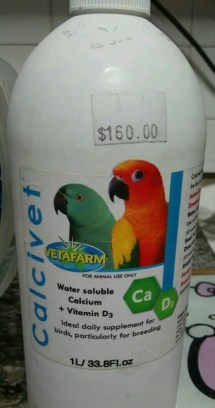
Liquid calcium is for hens. A cuttlebone does not work unless the birds are frequently exposed to sunlight. Also that the absorption of calcium is faster via liquid than food means. I see many people just give cuttlebones and sometimes their birds end up with problems. How many of us have the time to daily sun our birds? I favour Vetafarm’s Calcivet. I have tried Nekton MSA but as it is food-based (ie sprinkle on food) some birds just refuse to eat or eat less.
What about full spectrum lighting? I am not a fan of it because of the risks. Any closer than 2ft and the birds could go blind, yet any further it would be useless.
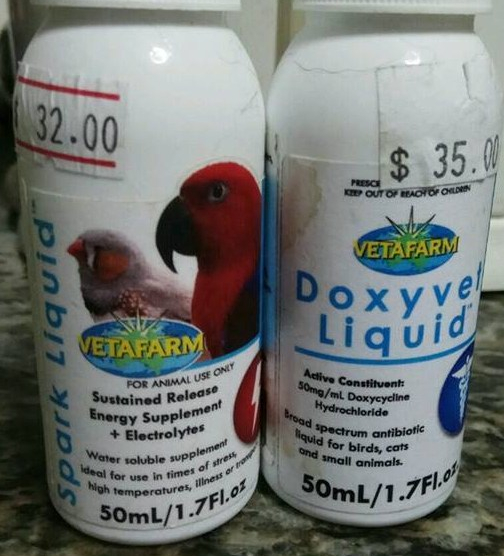
Spark by Vetafarm is an electrolyte and only reserved for weak chicks after hatching or if a hen is very tired after a bout of egg-laying or chick-rearing. This is for emergency use and is good to have on hand. It works more potently on sick or birds refusing to eat properly than a large amount of coconut water. The Doxyvet I have only used once and prefer to have it on standby lest it is ever required. I have seen birds die from overdose so unless you know what you are doing, skip that.
Vitamin supplements or breeding supplements. I have mixed feelings with regards to these as I have found that certain species do not need it (Eclectus in particular are intolerant of too much vitamins and by default quite horny) but if your pair is of age and not mating as much as they should at their age and if everything else is cleared (health, diet and environment etc) then you may consider using these. I don’t use them anymore. I have tried SELCEN-e liquid Fertility Enhancer and it seemed to only work on smaller birds. Nekton E and S together did not seem to do very much for larger birds that were already producing. Avitec’s Avigra (no longer produced) seemed to have zero effect and I could say the same for Versele-Laga. Remember that each pair is different and you may need to do some experimenting to find out what suits yours best.
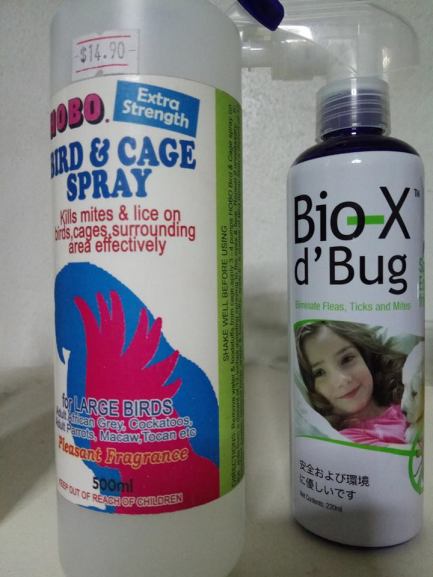
A good mite solution is needed if mites are present. In our humid climate a large percentage of birds/nestboxes have mites (*especially wood mites!!*) and I can call it inevitable unless your birds are very tame and allow you to change bedding and so forth everyday. I have found that Hobo’s Extra Strength mite spray actually works on mites and is very affordable.
Another powerful and safe brand – but use with caution as it is quite strong! I would not recommend it on small birds!! – I have also used so far is Bio-X d’Bug (LIQUID NOT AEROSOL SPRAY) but it is rather expensive. This is a Singapore product, I am sorry to say that for overseas readers. Lovebirds and small birds may need to add on SCATT on top of a mite spray. You may choose to put in the nestbox a small amount of Diatomaceous Earth by Para*Clear however if you or your bird are sensitive to very fine particles then better not.
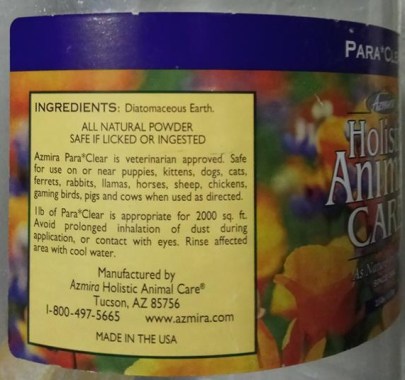
I spray the bottom of my trays and then cover with newspaper, not necessarily on the birds. Not a fan of the perfumed smell getting on to them or so much inside them. Do ascertain if your birds have mites first, if you have one single bird from a good breeder and do not bring it out the likelihood of mites is lower. Do wash your nestboxes if acquired from a shop and wooden. I have lost count of how many nestboxes I bought that came with wood mites. If you can afford it, go for a metal nestbox.
Do you need to deworm your birds?
Not necessarily unless you see worms in the feces. Some breeders give upon purchase as a precaution. I have given to my birds before and one pair of lovebirds refused to drink the water-based dewormer at all. 2 days later I noticed they were inactive and sickly and quickly changed to plain water whereby they drank in great dehydration.
A small note here. Friends and I have observed that Baxter brand cannot make it in terms of quality and effect.
And you can see breeding is not exactly cheap with the prices on the photos. There is the misconception that breeding is very profitable, sure it is if you mass-breed small birds or give the worst quality feed etc but when it is passion-based the profit margin can be negligible.
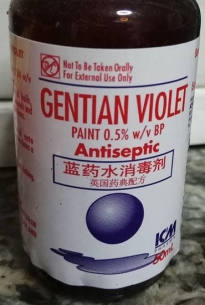
First aid items. Vet wrap for bandaging just in case of severe wounds. Betadine or the following purple liquid that we always got dipped in when we got hurt –

And indispensable is Beaphar’s Wound Ointment which I have found to work superbly on minor injuries. Along with a bag of cornstarch or flour to stop bleeding and Cayenne pepper as a painkiller.
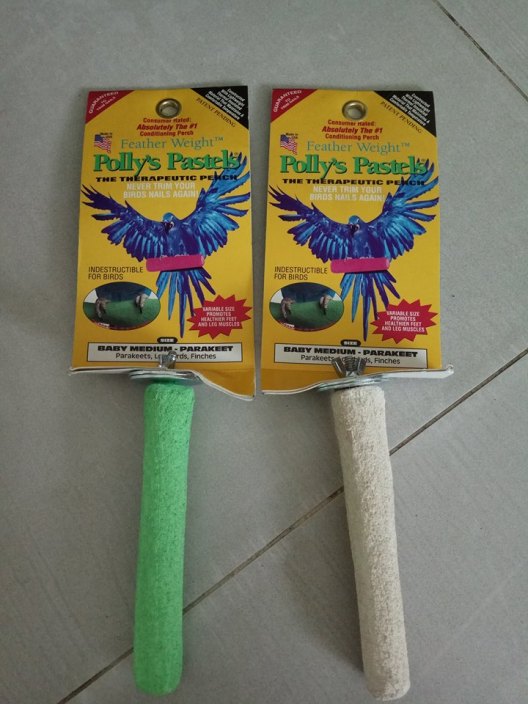
Polly’s concrete perches are the only pedicure perches that I use and have throughout the years found to be the most efficient. Yes it is very expensive but it works – and it works fast compared to say, Living World pedicure perches or those unbranded pumice and sandy perches. Safety is paramount…please do not use any unbranded perch simply because it is cheap. I despise sandy perches because birds can gnaw off the sand covering and I do not know if it is harmful if swallowed.
Take note to get the right size! Especially for lovebirds…their label recommendation is 1″ which is clearly too big for a lovebird and even in lovebirds – or any species – there is size variation (i.e Solomon Islands Eclectus begin with 1″ Polly’s perch but at full maturity may need 1.5″ diameter!). Polly’s perch will only work best if it is the appropriate size! I have also noticed it isn’t exactly indestructible…my lovebirds chewed off the edge of Polly’s Baby Small, much to my wallet’s great chagrin.
Why the importance of this perch aside from its efficiency? If your birds are not tame and their claws are overgrown you will stress them catching them out to trim them. Some birds may even stop producing for a while from fright. And you don’t want to have untame birds getting stuck from their long claws to the bars or some item in the cage – that has happened before and it was very stressful for both me and the bird as it was screaming non-stop!
You can only find Polly’s perches from Goodwill shop or from Birdsprees.com. I prefer to buy from shop because I can run my fingers on all the perches and choose one which I find to be not excessively rough. If you just buy online you cannot do that and it may come in an abominable colour that frightens your birds.
Wooden chewable toys. No string, no rope regardless of what ‘safe’ material it is made of. Chewing on destructible material may help stimulate birds to nest and in certain cases such as lovebirds they may carry off pieces to use in their box. I do not like acrylic or plastic pieces, nor round little wooden balls that may be hard to destroy or become a choking hazard.
If you do not give toys the birds may end up biting their wooden perches or may end up with some boredom-related habits. I have noted that sometimes birds also take out their frustrations from breeding on toys.
Selecting Or Acquiring A Pair
Now you’ll need the birds if you don’t already have them. Where to procure the pair? There are more horror stories than good endings. Everywhere seems to have pairs for sale. Shops, individuals…the list goes on. It is easier to just buy a pair from a shop right?
I came across this many years ago and saved it.
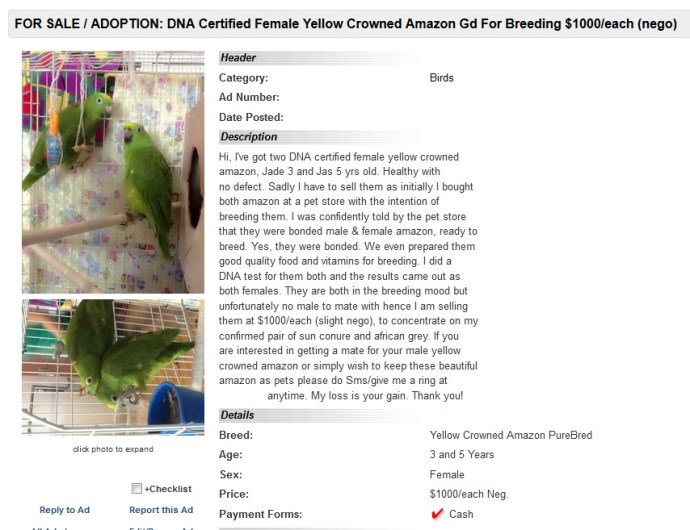
To my knowledge this pair went round and round even landing in the hands of two friends until they were split. There was also a pair of Hawkheads and Crimson Bellied Conures that were same gender and went around.
Another friend of mine acquired two pairs of blue Quakers from a shop and they came with assurance that they were male and female. This friend was a long-time patron and thought it was alright to trust. A few years later when they did not breed, he had them DNA’ed and all of them were female!
I am not calling out shops as evil but do consider that end of the day business is business. Some people have succeeded with bonded pairs from shops.
Buying proven/breeding/bonded/just ‘pair’s.
You must be careful. People are very sly with their words nowadays.
- Proven means the pair has produced babies before***(see further down)
- Breeding may mean that they have produced before OR just means mature enough to breed. Always ASK. If the seller is evasive, run.
- Bonded: Birds have not produced before but are bonded. Be wary that some sellers will say the birds are bonded when they are simply two single birds thrown together in a cage! Observe the birds or ask for sufficient proof that they are bonded!
- Pair: Just a pair of birds. So vague that if the price is high you should re-consider especially if not DNA’ed.
Should you buy a proven, or just a mature and bonded pair, or pair them yourself?
I acquired two supposed proven pairs from shops. Both were Eclectus. Both pairs never bred and as I kept them for a while I observed that one pair’s female initiated mating but the male did not mount her. The other pair was a horrible mix of subspecies that led to inability to mate (I will discuss this in a future article). Both pairs were bonded but clearly had issues which may have led to them being sold in the first place.
Total damage: $2500 + $1800.
After all these years, I still recommend buying proven pairs over mature and bonded and not waste time pairing up from young. Seeing a proven pair produce will also encourage you greatly. Of course if you have the time to spare, the best results would be to pair two young birds and wait for them to mature. But who is able to see the future, you must consider the what-ifs should situations or plans change. There are also what I call childbirth pains – going through the various stages before maturity – that could be troublesome and sometimes hair-pulling.
Some people don’t believe in buying proven pairs as they have been cheated before. Understandable, but if you are very careful and once bitten twice shy, it can lead to acquiring good proven pairs.
Networking is very important. I made friends with a breeder whom I consider my mentor. When he had to let go his birds he contacted me and asked if I were keen on them. Good relations will lead to people notifying you first before releasing to open market. And if you are close to that breeder AND observant (these go hand in hand!) you will take note throughout time if that pair or those pairs are really producing pairs.
I acquired several pairs of birds from my mentor. All but one pair which I gave up very early (see post on breeding African Greys) produced in due course. I got to know also another Eclectus breeder and over one year, watched as his pair broke eggs repeatedly but finally after changing nestboxes and so forth they started breeding (they were bought as a proven pair! Proven does not mean the birds don’t have habits!).
When he gave up on breeding I took over that pair. There is a saying that good things must wait and I agree with that. Observe, learn and wait. I knew that pair had a history of breaking eggs but was willing to give them a shot. And given enough calcium, the hen never broke an egg with me.
Just a ‘pair’.
Watch out! The less information you are given, the further distance you should put between yourself and the birds! Either the owners are hiding something or they do not know or cannot be bothered. In this era where DNA services are readily available and affordable, if you run across someone giving up their pair that you cannot visually sex and they refuse to DNA test them you should be cautious. DNA tests actually help to rehome birds easier because people are more willing to pay vs the risk of getting a pair of the same gender.
Some species such as lovebirds and Greys you can guesstimate with good accuracy the sex of a bird. As far as possible try to get DNA tested birds. Certain species such as caiques and lovebirds CAN bond and mate with a same sex partner!
With regards to ‘just a pair’ birds, you need to take a big pinch or better still a whole bottle of salt. More often than not the true age of the birds are unknown too or randomly generated. Worst case they could be DNA tested but the same sex and therefore owner claims they are not tested and do not know if the pair is male and female.
How do you think those Amazons and Hawkheads passed from owner to owner? My dear reader, that is just the tip of the iceberg.
The world of breeding is filled with dark deeds and twisted morals. If you thought that the bird community and hobby is swamped with drama and politics already, then entering breeding is diving into a pit far, far worse.
Important!
***Do take note to ask in detail about proven pairs. Proven pairs could be just a pair that had produced fertile eggs but do not incubate their eggs as they were taken to be artificially incubated, or bad sitters. Or they could sit but never had a chance to feed their chicks if taken away upon hatch or a few days after hatch (as per my mentor did) or worse, do not know how to feed chicks.
Make sure the entity whom you are acquiring the birds from have valid reasons for letting them go! The best pairs come from people who are aiming for larger species (and selling all existing birds) or a change of course in life and are quitting the hobby. You want to question why would anyone let go a good breeding pair unless it has, 1 – problems, 2 – they ran into trouble and most of the time it is the first.
Many people cannot wait for success or the birds developed habits or had habits they did not know upon purchase until later. Be wary if someone is only giving up one pair out of many pairs, perhaps that is the least productive or most problematic one.
Also very terribly, there are people who buy fertile eggs or very young chicks from others and pass them off as their own pairs’ offsprings! I know of a big breeder who bought chicks and eggs from a farm. Some of his pairs did produce later but still…pity the souls who bought his false proven pairs at high prices! One of my friends did and the pair produced in his hands shortly. The breeder was stunned and kept asking what did he feed and what was his setup like – and my friend immediately felt suspicious. If it were a proven pair why would such questions be asked?
Have I frightened you off purchasing proven pairs yet? The keyword is relationship.
~~~
I once acquired a pair of supposedly proven lovebirds from a friend I was not close to. I had seen her post photos of chicks and she assured me that the pair she was letting go was their parents. Oddly the collection point was not her place. But to give benefit of doubt in case she had been posting on behalf of someone all along I went and picked them up. Now because I trusted her – and assuming, y’know, friend… – I did not ask for proof. After I got the birds home, I noticed that they did not have signs of bonding, they did not feed nor preen each other even if they did enter the nestbox together. After a while I decided to stop keeping them.
Then the friend posted more photos of chicks later with the caption that they were from the same parents as the previous clutch! Instantly I knew something was wrong. If she had let go her pair to me, how could she have more babies – and claim they were from the same parents? Regardless, I did not bring the matter up to her but kept it within close friends until today, besides there was no point getting upset over a small sum. It was a great lesson.
Another friend acquired a pair of proven lovebirds off the Internet. This pair had two chicks in the nestbox so it looked authentic. In fact this is an old method of seeing if a pair is proven. Alas! The chicks were found dead in the following days, having starved to death. The seller had simply thrown two birds together with two innocent babies in an attempt to jack up the price. I had noticed this young man continually have pairs for sale but thought nothing of it until my friend was deceived.
Always, always do your research. Some people are just out to take advantage of others. Time will unravel everything.
Mature & Bonded/ Pairing Single Birds
Some people are unwilling to pay so high for a proven pair and settle for mature and bonded or pair up two single birds. Significantly cheaper but time is money, friend. Granted there are no guarantees even with proven pairs however the chance of succeeding again is higher than a non-proven pair. Not to mention the what-ifs should the pair not bond or take half a decade…
If you acquire a proven single bird – that is, a bird that was one of a proven pair but for some reason lost its partner – the chances of success will be higher than pairing two non-proven birds. At least one party knows what to do.
Proven single birds still command a higher price than a non-proven bird. Most people refuse to pay but I for one would definitely go for it, once again provided that the bird’s history is comprehensive. Knowledge of the bird’s personality is an advantage here. Also the longer the bird has become single, the better chance of successfully bonding with a new partner.
There are the cons, a proven bird could get frustrated with its new mate not responding as a proven one would or simply frighten the other bird with upfront advances. Hence details on personality is important. Putting two aggressive birds together or one aggressive proven with a meek non-proven bird can be disastrous!
~
I also acquired two pairs of bonded Eclectus from individuals.
One of them was from a reputable breeder of mostly conures and small birds. This pair would be my first time buying a pair of Eclectus however I did ask if they were related and was assured they were not. With the reputation of the seller I thought things would be alright. But the birds had consecutive leg ring numbers.
It wasn’t until much later after I pointed my suspicions to my mentor who ran a check for me through his friend who worked at the farm they were from that it was confirmed that THE PAIR WERE SIBLINGS! A mutual friend of me and the seller advised me to give him benefit of doubt so I did – maybe he was equally clueless – another expensive lesson!
The other pair was from a friend. They were under 2 years young and had begun feeding each other. I was still not very knowledgeable then and took them on based on photos and some videos. But it became clear upon observation – an important part of breeding – that they were far from ready. I did not want to wait since I had older birds and they were largely Solomon subspecies and rehomed them.
Total cost: $1600 + $1450
~
Also a tale I heard from a friend – his friend had a pair of Eclectus that were together since young. But upon reaching 6 and 7 years of age, they suddenly decided they did not want to be mates and fought violently. While the details are not there for one to infer the cause it is still something for your consideration. I have also heard a similar story from my mentor, also Eclectus and I do not know if it is only particular to that species but Eclectus do choose their partners. I will again, go into detail on this in a later article.
And to reiterate, if you are buying a bonded or even proven pair make sure to get sufficient proof. A lot of sellers do not allow viewing nowadays, understandably, so be smart about asking.
Joint Ownerships
Sometimes we can’t keep the birds we want due to money and space constraints. Then people may choose to co-own a pair or a few pairs of birds for breeding. One party keeps the birds at their place and looks after them and any resulting chicks’ value is split between them. These are tricky partnerships and must be looked at from a business point of view. Trust and very good relations are needed for any joint venture to work out especially in breeding. Birds may not breed, problems may arise and friendships can be broken.
I did enter one joint ownership deal once. I liked this pair of so-called proven Eclectus pair from a shop but could not afford it. A friend wanted to breed too but did not know anything about them. He offered to jointly own them, he would pay first and I would keep them and he would supply vegetables from time to time.
Unfortunately that pair never bred, they were not even a proven pair in the first place (this I knew later from observation) and as the months went by I felt some pressure whenever my friend asked if they had anything. After I noted that they were not going to breed, I decided to buy over them to leave the deal and also to preserve relations. (This is where a lot of friendships break up because one party is not willing to sacrifice) Besides, I wanted the male to re-pair. We agreed on installments and eventually I paid him off with relief. No relations were lost here, he understood that proven pairs were not guaranteed to breed (Of course I did not tell him why they were not going to succeed).
In other friends I have seen parties enter joint ownership and end up foes after that. Arguments over who should get how much %, birds not breeding or problematic…the more parties involved (some pairs had plenty of owners!) the more risky it is. Doubly so if the person keeping the pair at their place had more than one pair of that same species. If trust is not enough other parties could accuse them of having chicks but passing it off as their own birds’ offspring.
It is usually not healthy financially nor relations-wise to be involved in such complicated deals so I suggest if you are going to jointly own a pair of birds to consider carefully. A plan B is always needed before partaking in one lest somehow the party keeping the birds is unable to keep them anymore.
Pets vs wild birds
There are two sides to this, some people want their pets to be future breeders or want their pair to be tame lest if need to sell they would command a higher price. The other party prefers wild birds as they are purportedly easier to breed.
I’m on the fence with this one. Both have their pros and cons.
Tame birds tend to be noisier. They may be more keen on human interaction (I will discuss this further in each species-specific future articles) than on producing. Tame birds are usually more clueless when it comes to mating or looking after young. But you can take tame birds out to play and sun them easier, still enjoy them as pets…
Wild birds are untouchable. Getting them to sun and bath can be a hair-pulling experience if they are bigger birds. And the majority will make a din if you got too near. But because they are wild birds and frightened, they tend to bond easier because they have a common enemy – you. Note that tame, handraised birds that became untame from lack of handling may also be clueless about raising young or knowing what to do.
I like wild-caught birds that have become semi-tame over the years of being kept by humans. Those are the best breeders in my opinion. They know that humans are not going to harm them and feel relatively comfortable to produce and yet retain the instinct to mate and look after young. And if they have to be rehomed they settle down quick.
The details you need to look out for in getting any bird or pair:
- Claws. Ideally the less missing claws (especially on the male) the better. A bird missing a few claws can still mate but grip will not be as good as one who has all intact.
- Eyes. Stay away from those that have eye problems especially if it is the male.
- Pluckers. Plucked does not mean it is incapable of producing. In certain cases trial and error will be needed until success. Some pluckers are also the best producers.
- Size. Make sure you get two birds of near equal size.
- Leg rings if any. They are crucial to determining if the pair is related. Do not think that the chance is remote, Singapore is a very small country!
Bird rooms
Some people – including me, for now – have a room or balcony solely to keep birds. Not everyone has this privilege and not all species require one. Ideally if you can afford the space, a dedicated area to put pairs is advisable. Certain species particularly African Greys need that privacy. Both wild and tame birds may stop mating if you walked past them.
Some people choose to cover their birds’ cages for privacy. I find that in our weather it may be overkill and very hot. It is also not good to keep them in some constant darkness long term. Not to mention the dangers of birds chewing and swallowing or getting entangled in blankets.
One thing I like about having a space just for the birds is that cleaning is easier and also more healthy for us humans. I have for a period of time slept and stayed in the same room as the birds and I can tell you it is very detrimental to health. I cannot imagine how I was able to survive the bird dander. You may not see the dust but some time down the road you will notice your health going downhill. It is not worth sacrificing health for money or animals. This applies to sleeping with your pets regardless of winged or how many legged.
Take my word and just don’t do it. Rather if you can afford it, get a glass or partition for the room.
More to come, I have in mind to write about propagating Congo African Greys, a few subspecies of Eclectus and Blue-masked lovebirds along with a few snippets of other species I’ve had throughout the years.
Why did I write this, perhaps friends will ponder. Aren’t there risks that I should worry about? I did think on that and that may have been partial cause of the delay on this post – record shows I started in June – but I am at the tail end of this ‘career’. With a full-time job in addition to school, having chicks is more burden than blessing. I simply cannot commit the time anymore. This venture is not a shake leg thing.
The majority of my birds are with several trusted people now thankfully, so I can focus on life ahead. I expect to get some flak for sharing my experiences especially from those who breed simply for money.
But still I rather not prefer newbies get cheated or follow others blindly. I have seen people new to the hobby shoot to fame for being vocal or having large numbers of birds in a short while but end of the day experience teaches the most – and takes time.
~
The photo of the chick in this post was my first baby. It’s parents were siblings. They laid many fertile eggs but only one made it to hatching, unsurprisingly. I loved this little baby but it did not survive past a few days likely due to inbreeding and my inexperience. That was in 2014 and it still hurts when I look at old photos because I love chickens.
 LukeJade.com
I am shocked to read the following on your article regarding mites and lice. Quote:
A good mite solution is needed. In our humid climate 99% of breeding birds have mites and I can call it inevitable unless your birds are very tame and allow you to change bedding and so forth everyday. I have found that Hobo’s Extra Strength mite spray actually works on mites and is very affordable (You can get it from Petsmaniac).
Another powerful and safe brand – but use with caution as it is quite strong! I would not recommend it on small birds!! – I have also used so far is Bio-X d’Bug (LIQUID NOT AEROSOL SPRAY) but it is rather expensive. This is a Singapore product, I am sorry to say that for overseas readers. Lovebirds and small birds may need to add on SCATT on top of a mite spray. You may choose to put in the nestbox a small amount of Diatomaceous Earth by Para*Clear however if you are sensitive to very fine particles then better not. end quote
Now, I cannot speak about mites for your location in Singapore, but in the USA we simply DO NOT FIND MITES OR LICE on parrots. period. How do I know about mites? I grew up on a farm and worked with poultry…so I personally know about mites, what they do, where they live, how to find them, etc.
MITES AND LICE DO NOT MAGICALLY APPEAR. They do not come with our birds UNLESS those birds have been exposed to POULTRY or WILD BIRDS or the owner has given the birds a cage or equipment that has been exposed to poultry or wild birds.
Now, mites stay in wood crevices during the day and climb onto the birds to suck blood during the night. Lice stay on the bird all the time, which means it would be very easy to see them in the feathers upon inspection. As for the mites, they might be found crawling on the wood or in the crevices of the wood during the day.
ALL chemicals are a threat to our birds. Therefore, I would not be using any mite or lice powders UNLESS one has observed a louse on the bird or a mite on the perches! Otherwise, you are putting your birds at an unnecessary risk! So, if someone is worried about lice or mites, LOOK for them on the bird or perches before using ANY chemical products on these birds.
LikeLike
Laurella, most of the birds here are acquired from shops. Practically every budgie, and lovebird has mites and most beginners don’t know that sadly until they see crusty stuff on their ceres and feet or hear clicking. If I can (since photo taking at shops are disallowed) I’ll get you some pictures of most shops…wild birds simply jump up to the cages and feed on spilled and leftovers. Imported birds are also quarantined at shops selling birds…the list goes on.
Bird social meetups or gatherings are also very popular here and there are chances of getting mites from someone else’s bird.
I do not spray on my birds, but rather their trays then I put newspaper over it. I have read of your mention somewhere on FB that a bird dropped dead after being sprayed…let me edit my post to clarify that I only spray on the bottom so people can be more careful.
LikeLike