Eclectus Keeping

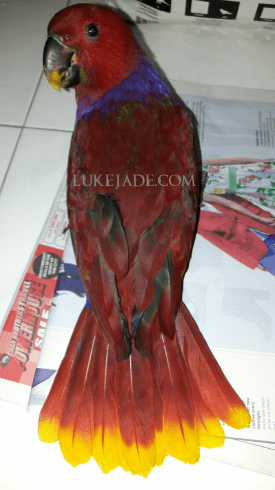
The E.R Vosmaeri


Note (16th May 2020): Due for update. Some sections need to be expanded and inaccuracies removed.


In this post is a my overall take on the Vosmaeri, an in-depth look at the appearance differences between a pure and a crossbred bird and the similarities between the Vos and Aruensis males. Prepare for text wall and picture spam! All the photos I’m using here are my own, or belong to friends (with permission). None are sourced from the ‘Net.

The Internet has plenty of insightful articles but some friends would rather hear from someone they know.  Just remember that some people / shops will say or do anything for money so always cross-reference with other sources.

The following is based on a local context. Singapore.


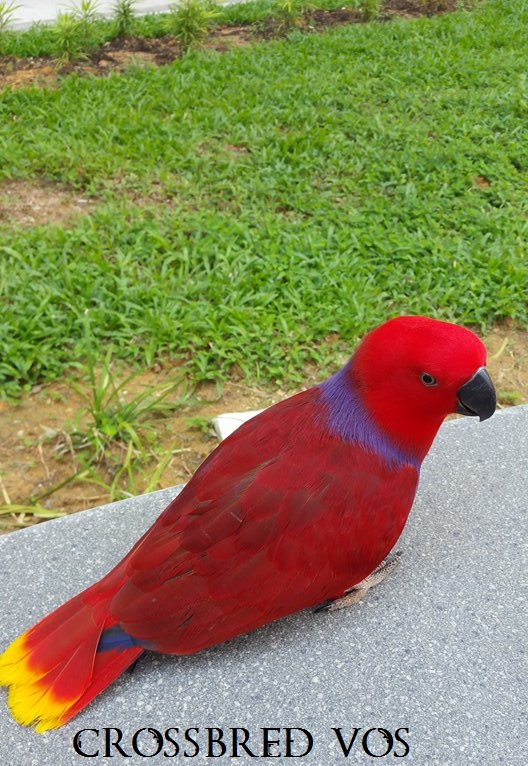
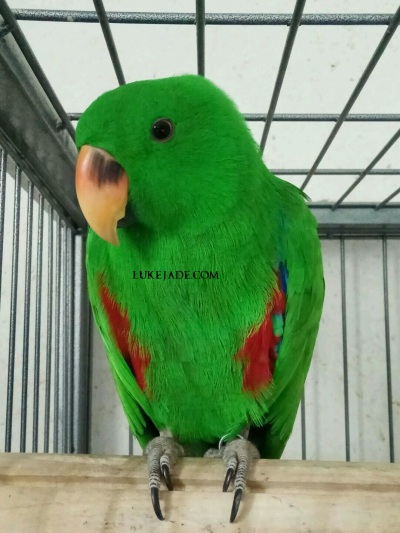
The E.R Vosmaeri. The most intelligent of the 4 available subspecies here and arguably the best in appearance, although it is regrettable that people do not value the male as much as the female. Both male and females are excellent talkers, especially so the females whose nature enhances that ability.

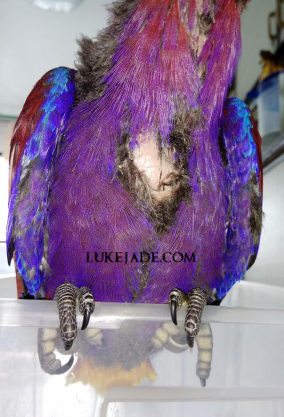
Ridiculously hard to keep in terms of dedication. Due to their intelligence and being extra sensitive, one wrong move and the bird could lose its feathers. I’ve been there. A new brand of pellets. Toe tapping, wing flipping and feather loss. An empty food dish – snipped feathers. A medal should be given to local owners who manage to keep their bird fully feathered throughout their entire life.

They are quiet, until maturity. Loud but not noisy as the Solomons which are softer and produce more frequent calls.

In 2014 I saw with my own eyes a pure Vos female and fell in love.

Many people do not care if their Vos are pure or not. Understandable from a pet and hobbyist point of view. But that does the species no good and inevitably when that impure or crossbred bird matures and takes a liking to another subspecies……


There are a few things to look out for when acquiring a pure Vos. It is easier to identify a pure female over a male so let’s go into that first.
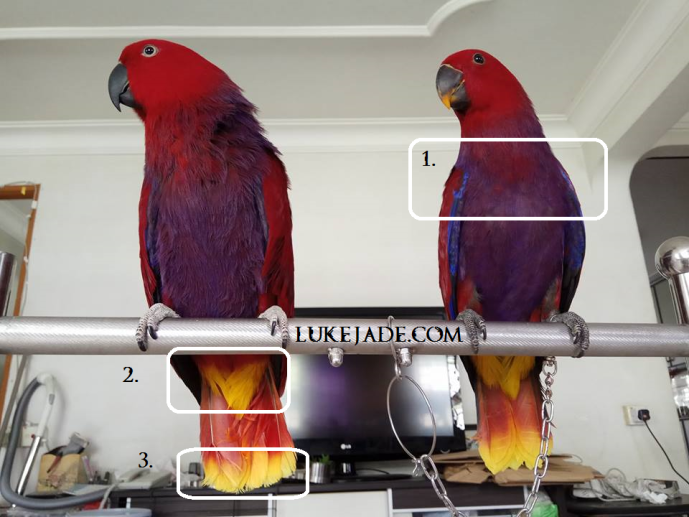
LJ1


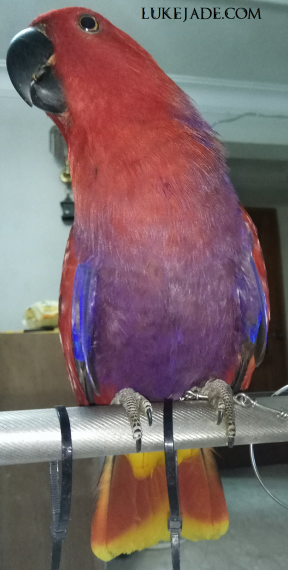
I had to butcher that nice photo. Left is a mature bird, right is a youngster.

  1. There is no definite distinction between the red and lavender chest feathers (or a bib). 
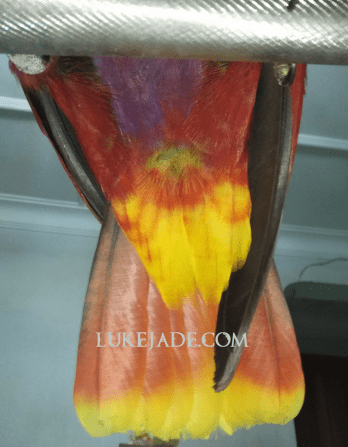
  2. The vent feathers are a pure yellow.
  3. There is at least an inch of yellow on the tail top side (circled is under tail).

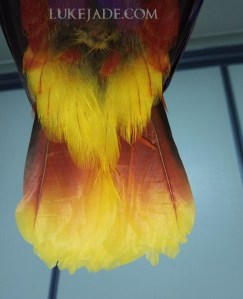
So here is a close up of a pure bird vent and tail. It’s the right bird on the photo above.
27972265_10156075754426303_2671984875052989451_n


Splendid isn’t it? And it’s only a 2 month~ youngster. At 6 weeks old I was certain that she is a pure bird with a large yellow vent and a lack of a defining bib.
LJ2.png LJ2-1


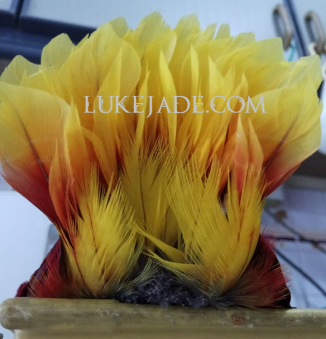
Some pure birds have a tinge of red on the yellow vent feathers.
LJ3 LJ4


So you would need to look at all three criteria for purity. The two tails above are of different females:
LJ3-1.png <- Left

LJ4-1 <- Right


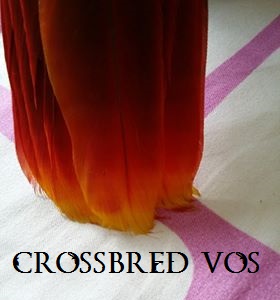
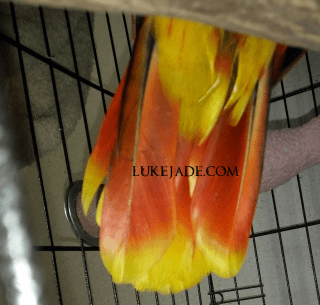
Now let’s look at the tail. Pure females have at least an inch of yellow tail.
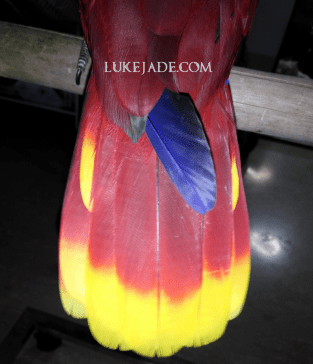
LJ3-2  LJ4-2 LJ1-1 (All 3 are different birds)


That inch of yellow comes as a chick. It does not develop only later! Same goes for the yellow vent and lacking in bib, all these qualities are present in pure female chicks.
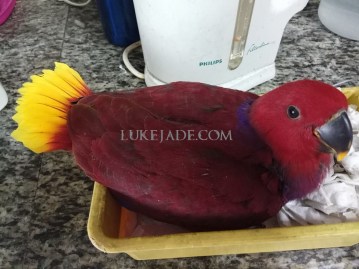
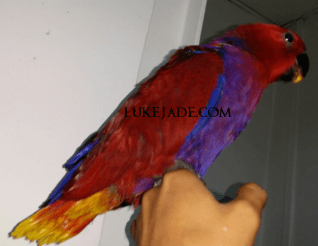
27657599_10156039103331303_4528097149497989204_nLJ4-3LJ3-3 (All three are different birds)

I have come across cases of sellers telling people that the yellow tail grows later and that is not true of a pure Vos female!

The amount of yellow will increase with the first few successive molts as the bird reaches maturity but it must begin with no less than an inch as a youngster.

Now you know the 3 identifiers of a pure female, let’s have a look at the impure or crossbred ones. Beware that there are some VERY nice crossbred female Vos around and it is easy to get confused.


This is the chick I first had. The father was a Vos as I was told by my mentor (a friend who had been breeding for many years and the source of some of my initial pairs) but he did not say if it were pure or not. The mother was a normal Red-Sided from a local farm.

The father had a Vos partner previously but she flew away before success.
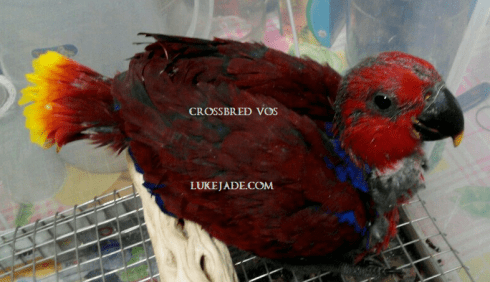
LJ-I5-1

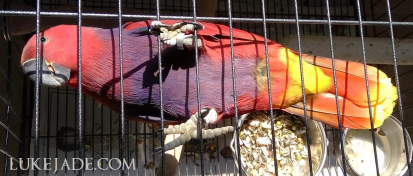
This chick, she had a blue-purplish chest as a baby which turned more blue as she grew. You can see her defining bib too as she feathered. She is also darker red than a pure female.
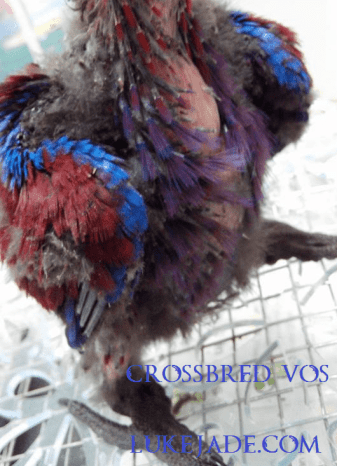
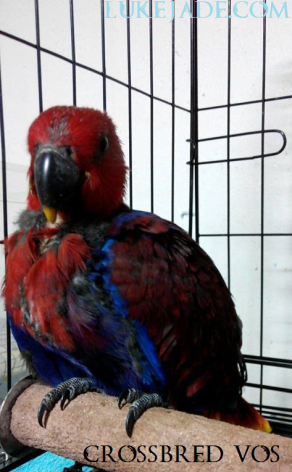
LJ-I5-2   LJ-I5-3

I have observed that crossbred Vos female chicks may decrease or increase in yellow tail amount. A pure Vos chick does not lose any yellow in it’s tail.

So how did that chick look like once it got older? As you can see below…the lovely yellow as a chick shrank. Her shade of red was still brighter than a Red-Sided but nowhere near a pure Vos’.
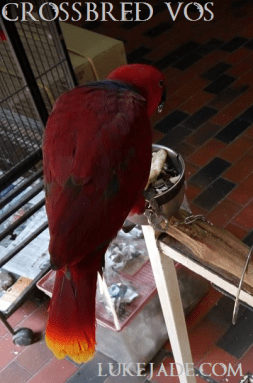
LJ-I5-4


There was another crossbred Vos youngster I met in a farm. It had no yellow on it’s tail at all when I first saw it. Even the vent was red, if you can zoom in.
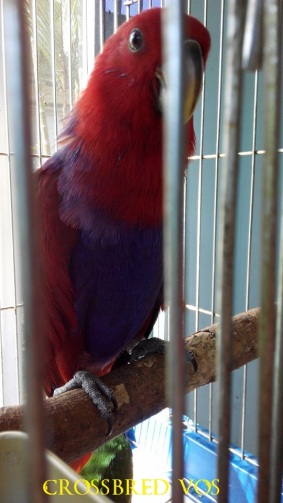
28660551_10156131024511303_8920216284733558137_n

A friend took over ownership of that one and kept it for a while.
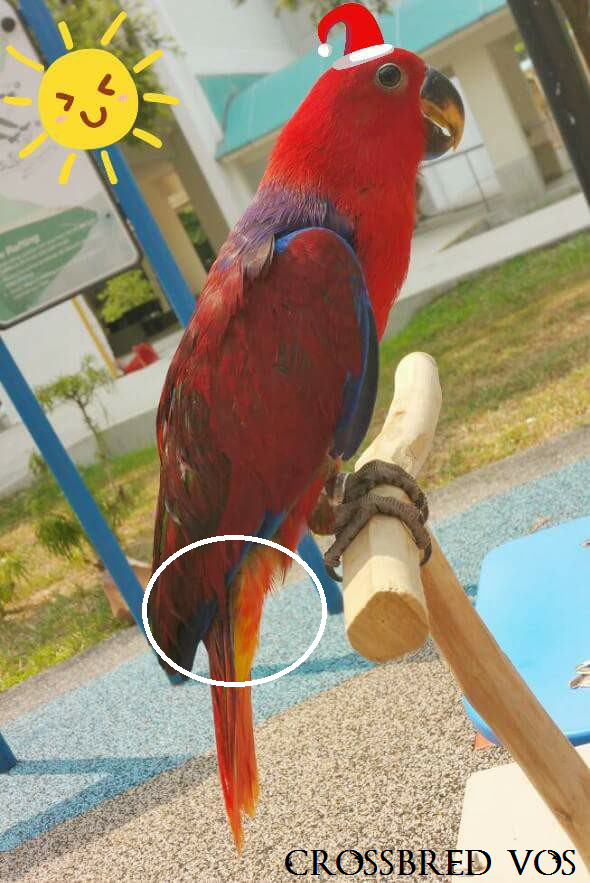
LJ-I6

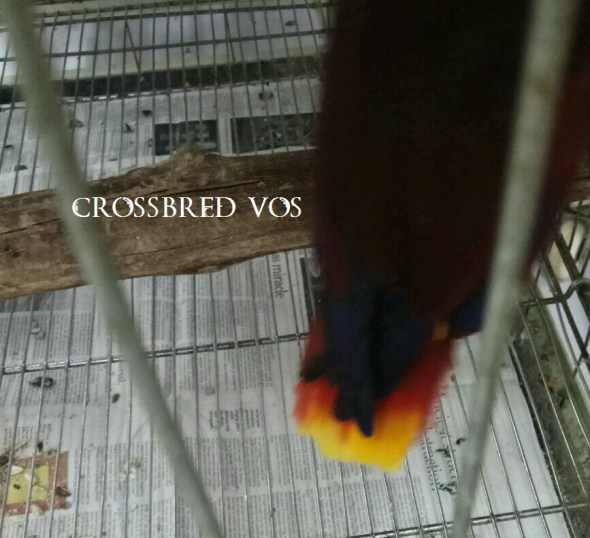
I decided not to shrink that picture so as to give a better look at the vent. Compare that with a pure bird at the beginning of this post. That’s literally the biggest sign of a crossbred Vos. This female grew yellow tail feathers during a moult and her vent became yellower!
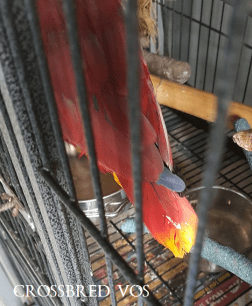
LJ-I6-2

Crossbreed birds come in many different variations. Here is an example:
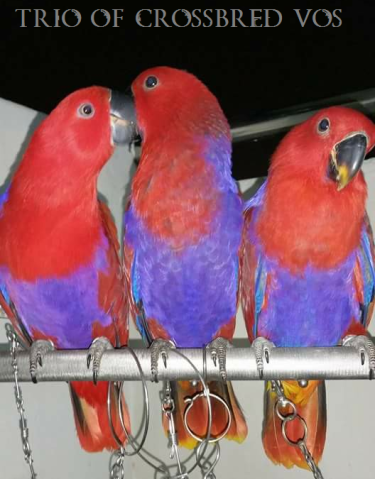
LJ-I56

Left has a purple chest but no yellow tail. Middle is my first chick as depicted at the start of this section, with a smaller bib and tinge of yellow tail. Right is the same bird above that my friend took over with a red-yellow vent and slight yellow tail. None of them had a blue eye ring.

The same parents of the middle bird produced another female with a yellower tail. I had the opportunity to take a photo of her next to a pure female.
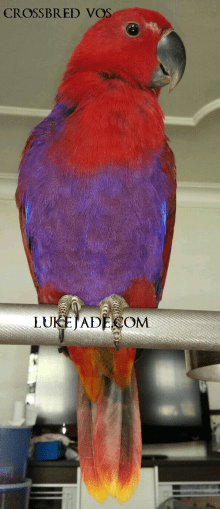
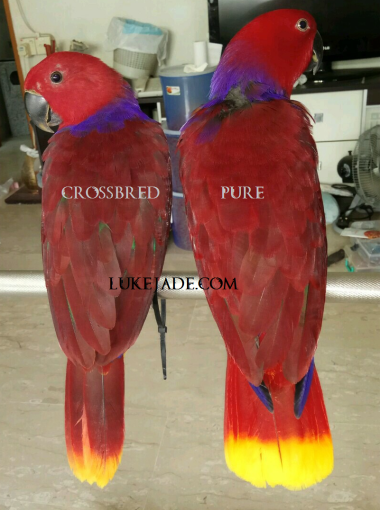
LJ-I7-2         LJ1-I7

Once again there is a definite distinction between the red and purple feathers forming a bib, predominantly red vent and limited yellow on the tail. The shade of red is darker. Her chest and nape colour is also more blue.

If you are wondering why I didn’t just stick that pair picture at the beginning and call it a day, I thought I would drill in the photos of pure birds first then show the crossbreds. When you first appreciate the beauty of a purebred, anything else becomes less so. Then perhaps you will understand why many people including me, push for purity. It is not only about appearances but genetically there is also a need to preserve them.

A photo of a tail feather comparison of the two birds above:
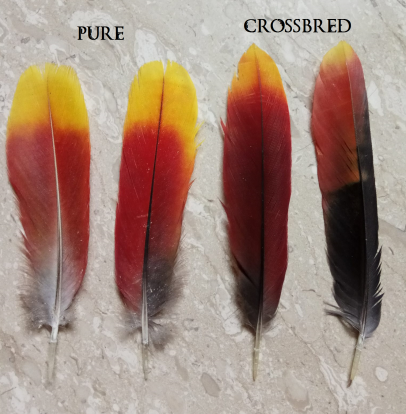
LJ1-I7-2


Alright, on to some nicer crossbred females. The above are obvious crossbreds and then there are some that leave you scratching your head.
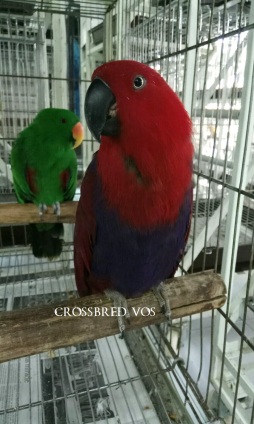
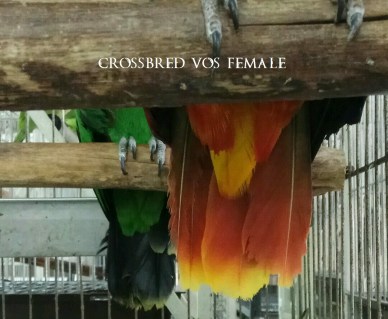
85   8788

I took the above at a bird shop. I asked and was given permission. The female above had a beautiful yellow tail. I’m not that proficient at taking photos but she had about 1.5~cm of yellow.

A crossbred bird’s tail usually has a darker shade of yellow if present and often goes from orange to red gradient. Observe that the female above also has a bib. And of course heavy red in the vent feathers. But a lovely bird all the same.


Here is my favourite example of how beautiful certain crossbred Vos can be:
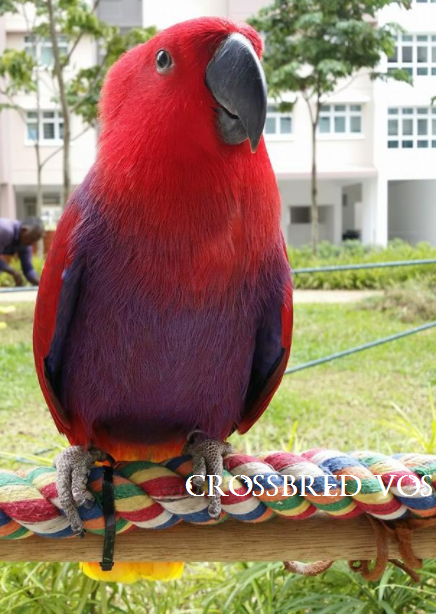
roro128383482_1865653376778576_1571771103_n

She has a fine yellow tail that’s for sure. Bright red too. And her chest does not look like it has a clear division of two colours. But there is a bib. For years I thought she was a pure bird until I sought a Vos from the same farm she was from and to double check, asked Rudy Caccia – an Australian aviculturist well equipped with knowledge of eclectus especially Vos – and I was stunned.

I spoke with the owner later and he sent photos that proved Rudy right even if I had not believed him completely at first. Here, a look at the bird when it was younger:
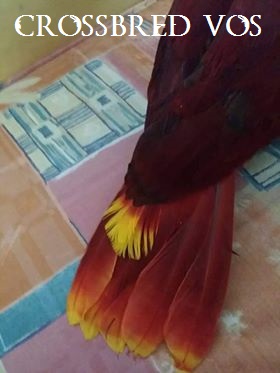
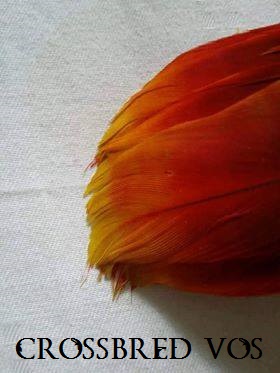
12825093_10153960337161303_705627409_n1101484969_763322017011723_1597989538_n

I also managed to retrieve an old photo of the bird’s vent recently and look at it! It is completely yellow without any red. The only thing is that it is a dull yellow opposed to a bright yellow in a pure bird. It is amazing. Her bib is very definite here and also the lacking in yellow tail.
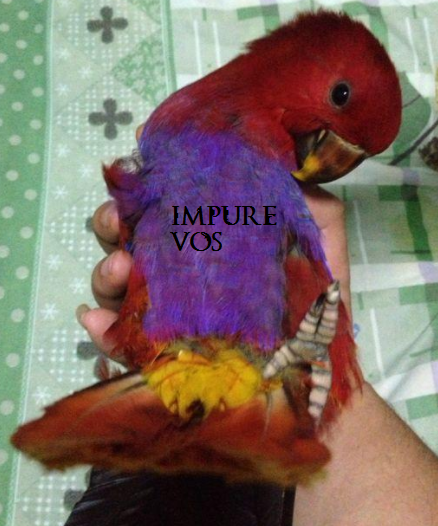
roro2png


A friend later bought a female Vos chick from the same farm and sent me a picture of her vent:
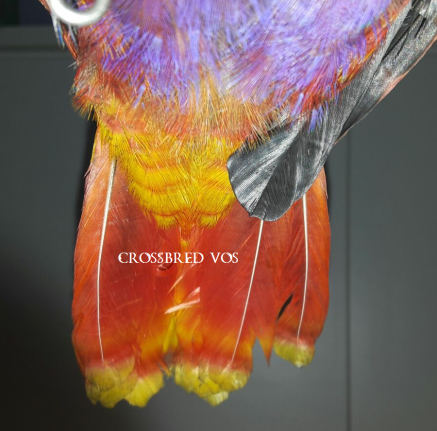
lawrence1

The tail tips look like the tail of the other bird above doesn’t it? Unfortunately this youngster died shortly after, so there is no chance of seeing how yellow its tail could have grown.


Now onto the males. In order to determine a male Vos’ purity you need to look at his sister or his offspring assuming the female partner is pure. That’s it. Lesson over.

I do not have many photos of local pure and crossbred male Vos, due to the lack of popularity few people keep them.

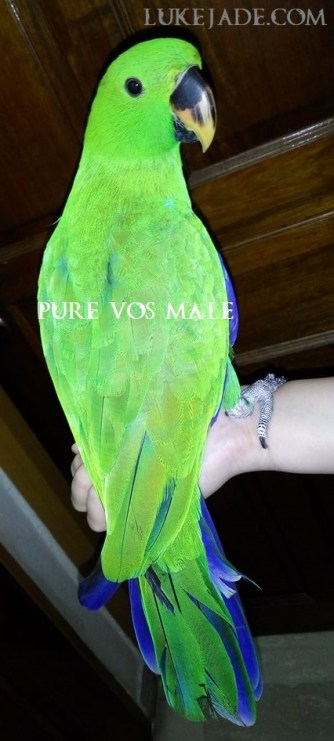
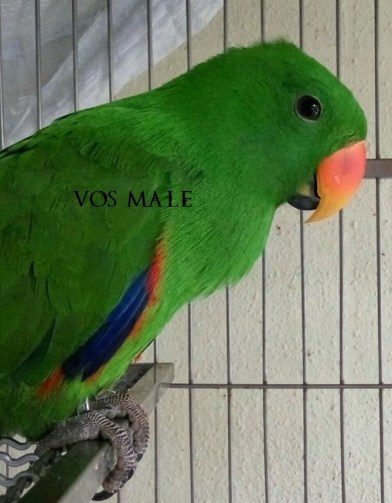
The first thing you see about a pure Vos male is the length of the bird. He is very long and most streamlined of all the subspecies here. Note that I mention long and not wide. Some people say Vos are big sized due to their length. But they are not bulky-big.

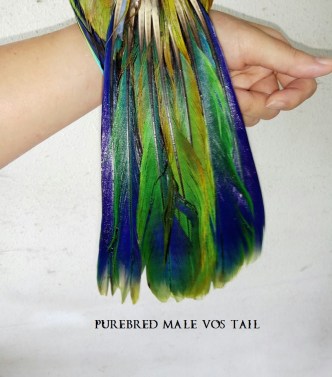
The length of a pure male Vos comes from his slender body and long tail.
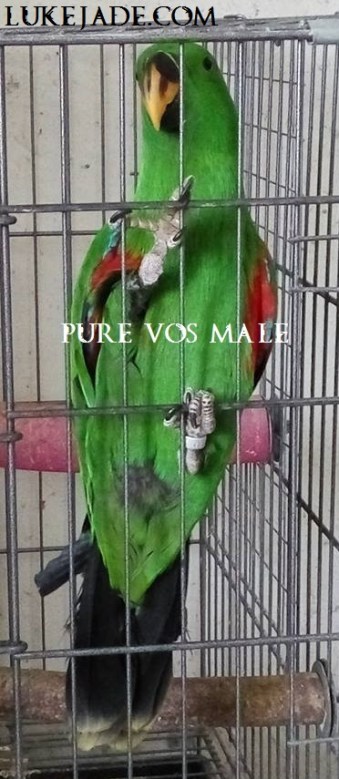
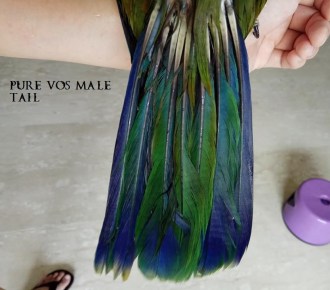
29249429_10156166195886303_6484607873371340800_n 29196909_10156166193316303_7903307099625488384_n28279001_10156108078916303_566841270921761797_n  28168045_10156108078616303_4516819739191416225_n

That’s plenty of tail to look at.

So how does one tell a male Vos (if not going into purity) from other subspecies?

  • Tail length
  • Tail contains a large amount of blue
  • Least amount of yellow in the tail tips compared to other subs
  • Beak and head shape

He is also a brighter green but many people have difficulty telling shades apart so I will not go much into that.

Another tail photo showing the blue amount:
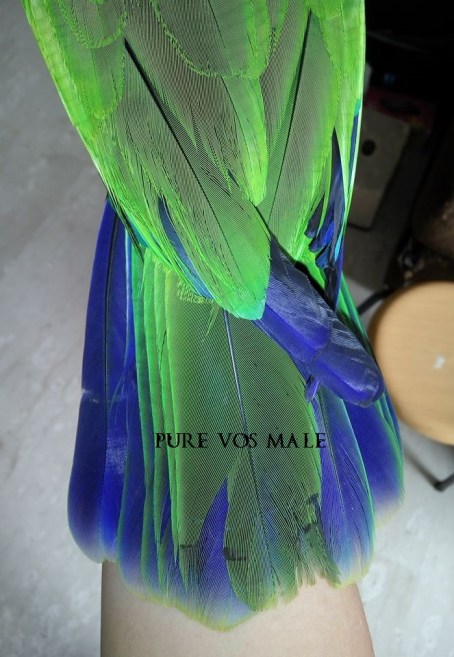
29197314_10156166197936303_7669804992055738368_n

And another showing the length of 165mm. There are variations in the lengths but a male Vos’ tail should not be something ridiculously short like 150mm. The tail tip has only a tinge of pale lemon. Faded yellow if you want simpler terms.

***Certain pure males may have a darker shade of yellow, in that case you would need to see his offspring to be sure of purity.***
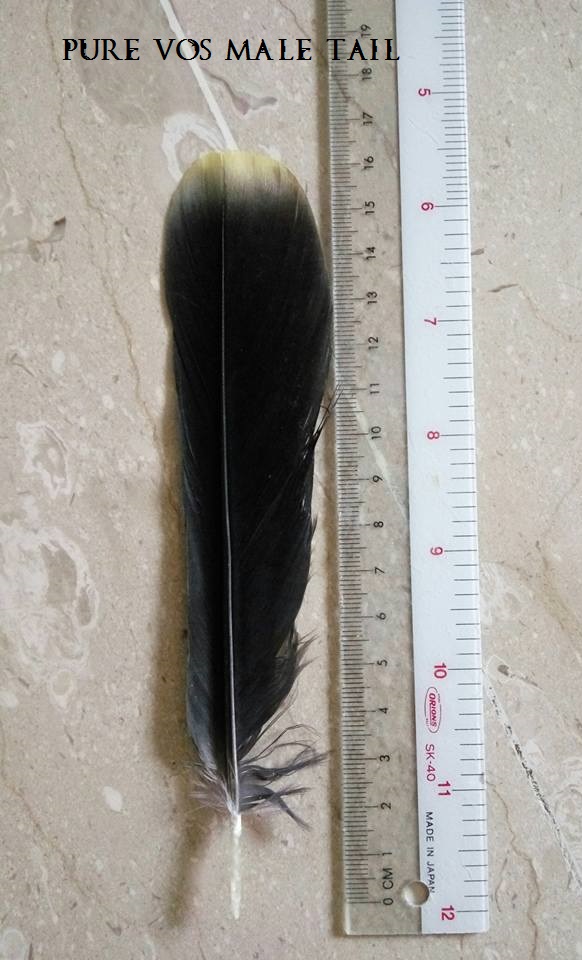
14502739_10154527797281303_9157670760136885875_n

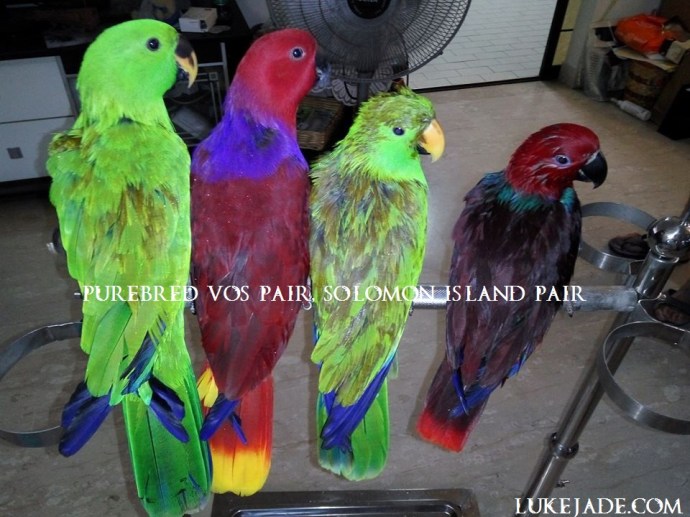
One of my favourite photos depicting the size difference between Vosmaeri and Solomons.
29186936_10156166197241303_2080157179481948160_n


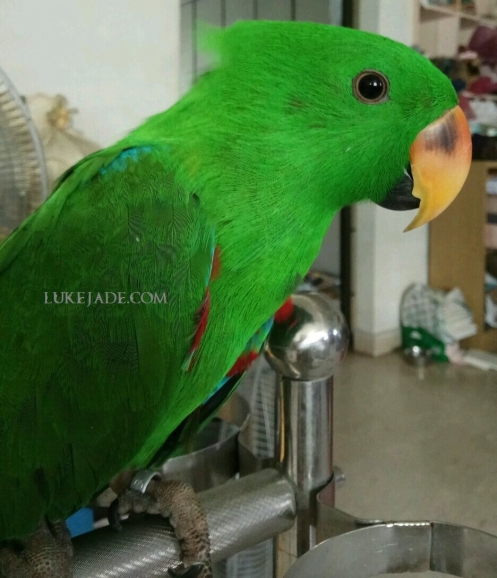
And we have the flat head with a small curved, elegant beak.
727729313652_10156166203001303_6505440582175817728_n

A male Vos’ beak should not curve out excessively like that of a Red Sided or Aruensis. If it does his purity is questionable.


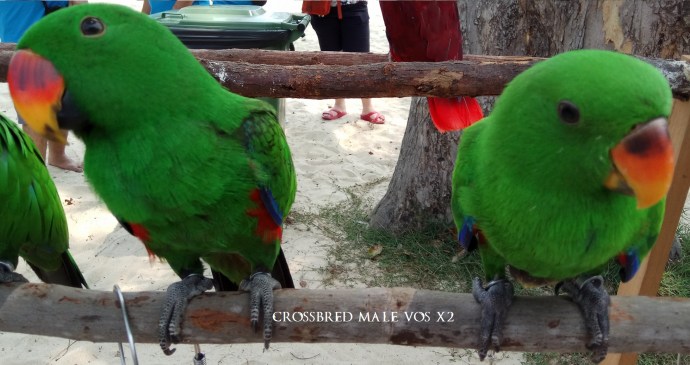
Here are some photos of crossbred male Vos. They carry traits of pure birds, which is why it is safer to look at a female sibling in determining a male’s purity.

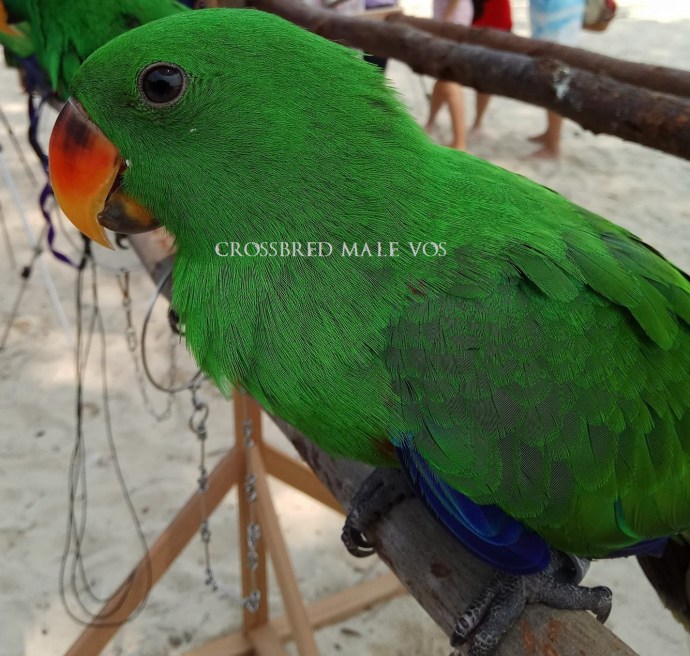
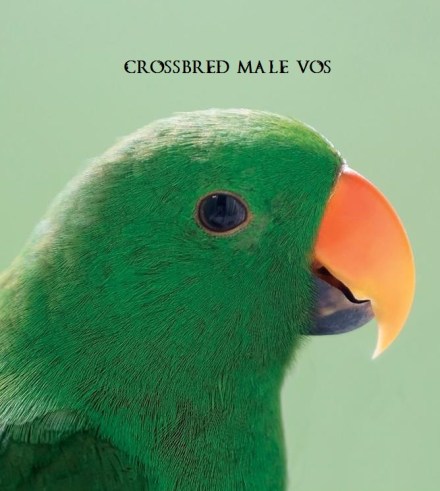
Both males below are crossbred Vos. The one on the right has the Vos beak shape and head. The left male has an oversized beak.
40

Bird on the right:

37

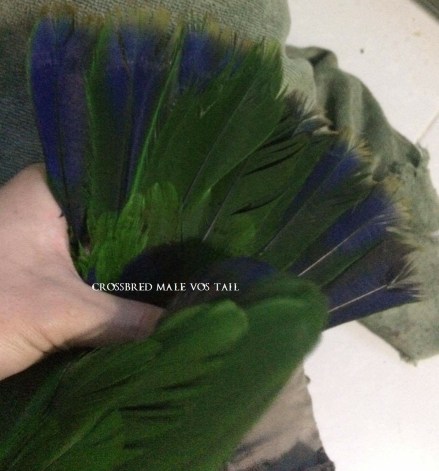
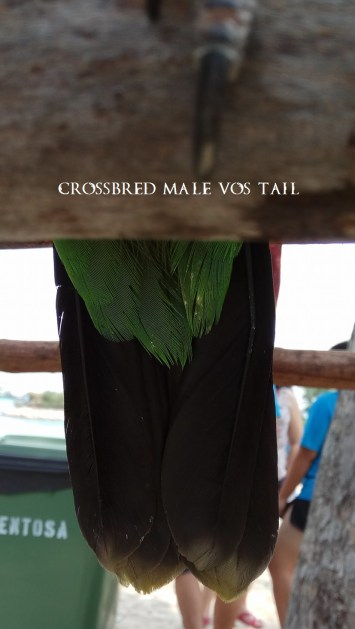
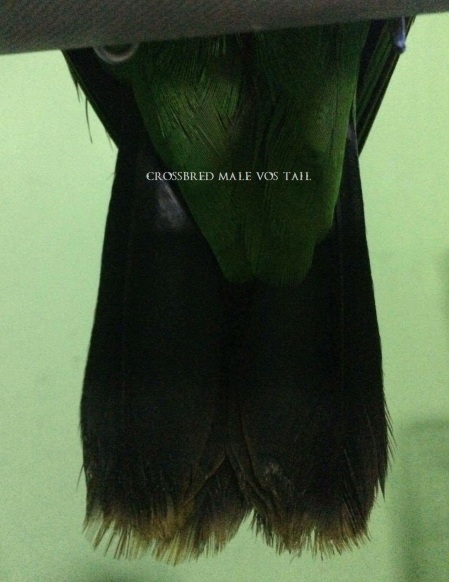
Tail of the male on the right. It has very little yellow. But not long enough to be a pure bird.
38

Check out the longer tail of the left crossbred which does not have a Vos beak shape.
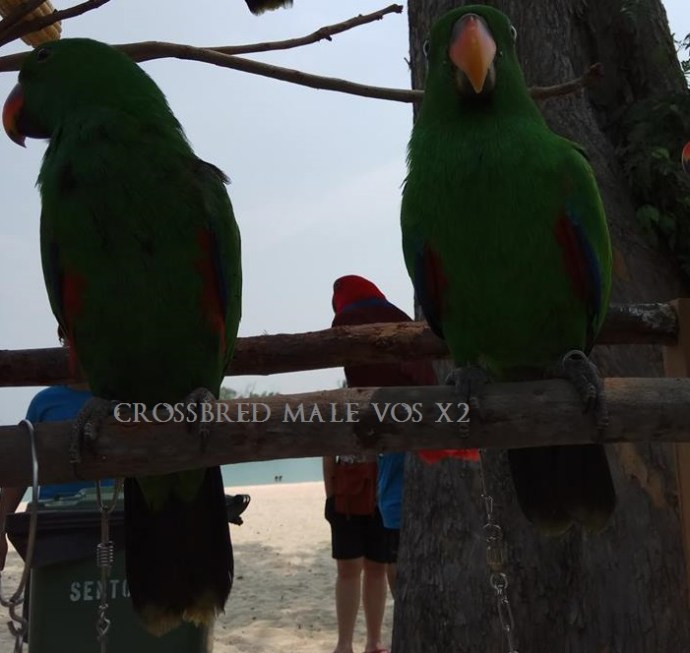
29187265_10156166361171303_8406081030766723072_n

The over-tails of both birds:

Bird on the right – the lack of blue amount and short tail length is very noticeable.
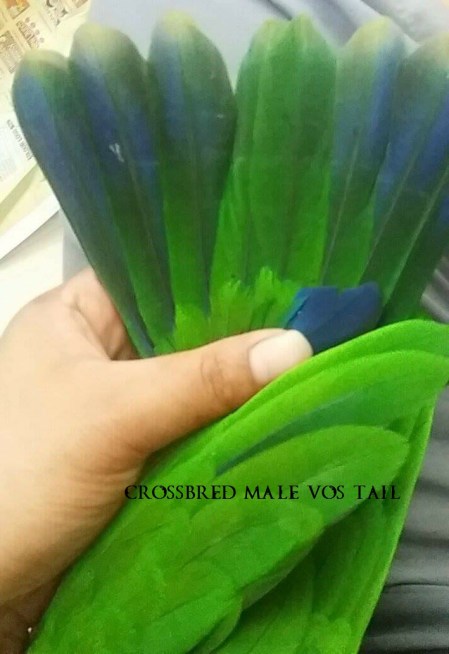
100

Tail of the bird on the left: Has a large amount of blue and length (but still not there).
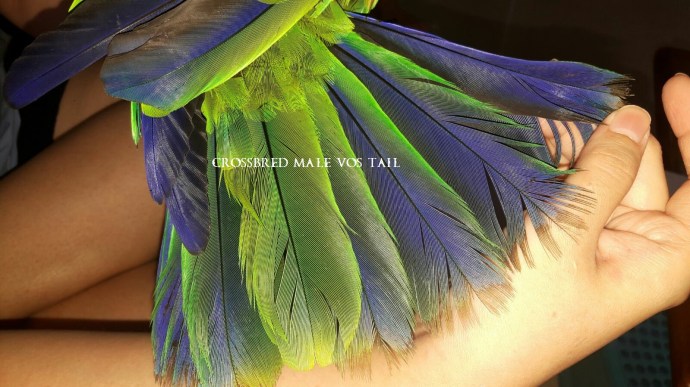
99

Here is a full body shot of the bird on the left and also owner of the tail above.
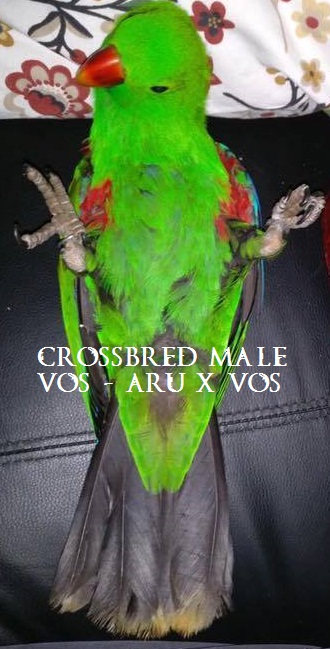
18620374_10155255037456303_2678661649682665510_n

Aside from having a larger beak than a Vos should have, it would have been hard to tell that he is a crossbred at that time when the photo was taken. The only clue you get from the above picture, is the bit of orange tinge on the tail tip. The Aru and Vos genes combined to form a lengthy tail.


Here is another crossbred male. The beak curves outward too excessively in proportion to his head to be appropriate for a Vos and the head is not as flat.
13782295_10153743801488671_1188863460757030510_n

And his tail which is lacking in length.
102104

An observation of the crossbred males in this post, all of them have very little yellow tail tips. I’m referring to the under tail.


Now a little bit about the Aruensis males. Many people get them mixed up with the Vos because they are both long, almost the same shade of green and both have copious amounts of blue in the tail (the Vos have more). And their tail length is nearly equal.

Let photos do the talking! Left is a pure Vos, middle is an Aru cross and the right an Aru.

You can see the Vos is more luminescent green. Look at the beak differences. As for the yellow tail tips, the feathers are bunched together making it look like it contains more yellow.
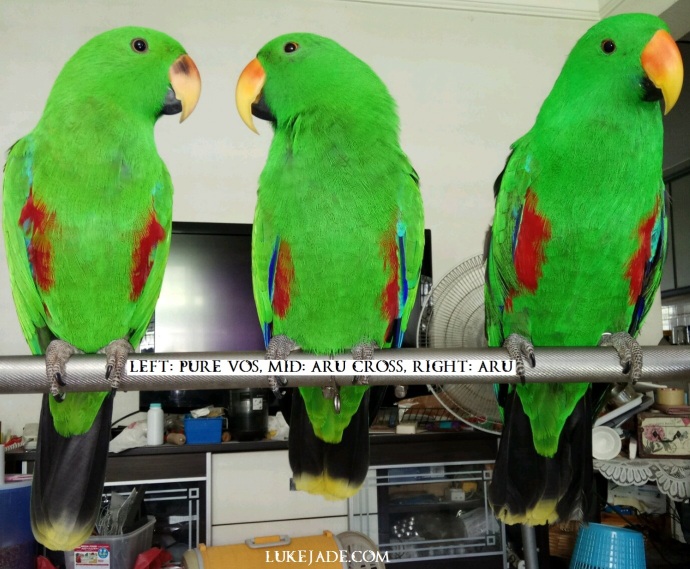
73


From the back. A length comparison. There are big and small (usually stunted instead of actually small) male Vos but some can be the length of Arus! You can see the Vos body is not so bulky.
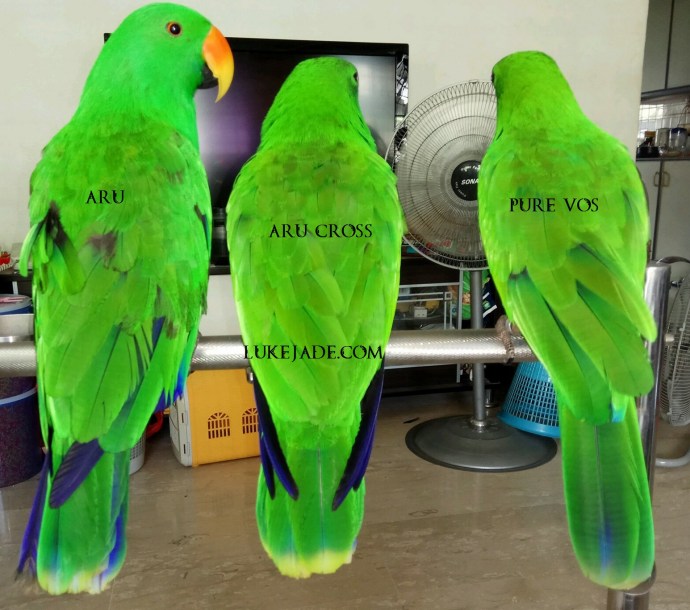
74


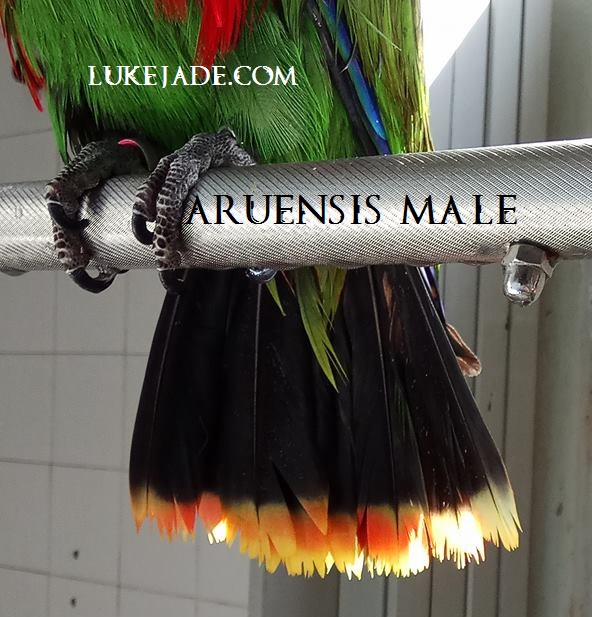
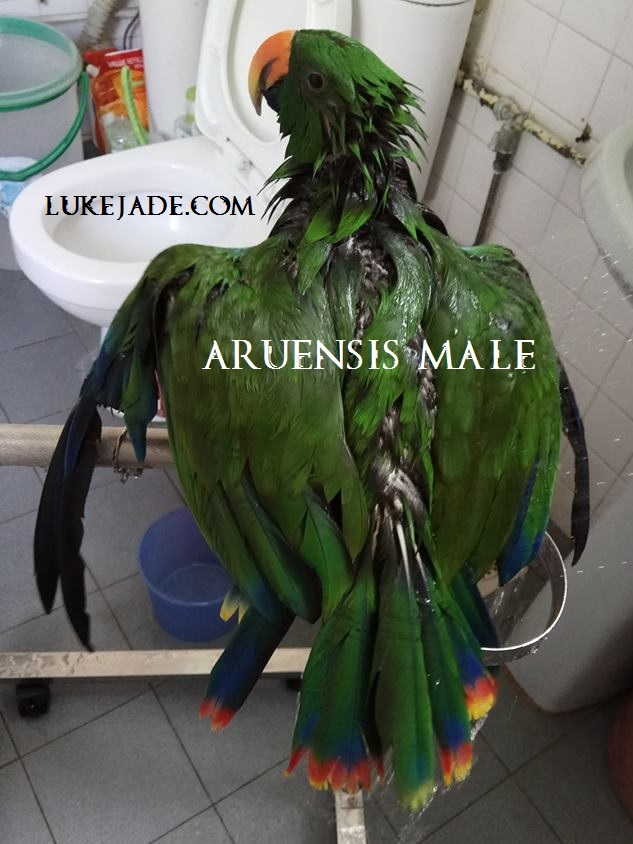
So what is the biggest difference between an Aru and Vos male? The tail tips. An Aru male has extensive yellow on his tail tips that a pure Vos does not have. Sometimes Arus also have other colours in their tails (which though is very common in Red Sided youngsters too, only the Arus sometimes keep their rainbow tails in maturity). A Vos male NEVER has any other colours in his tail tips but pale lemon be it youngster or mature.

This Aru male below is 4 years old at time of post. You would not believe me if you only looked at his beak markings.
29216668_10156168684426303_7146001354845061120_n29313204_10156168688546303_8191645193556983808_n

I will write about the Aruensis another time, hopefully. I do not have sufficient knowledge to safely show people beyond the basics.


A conclusion.

Part of why I wrote this article is because so many people have come forward saying they were offered a ‘pure’ Vos at a very good price or bought as a Vos but the birds turned out to be otherwise to their disappointment and $ loss.  There are also more and more sellers claiming their birds are Vos or Aruensis in order to sell a higher price due to their supposed size. Beware also of smuggled birds, always buy a bird with a closed leg ring!

You need to be careful buying a Vos. Make sure the bird is at least 2 months old so you can gauge if they are pure. Look at the female sibling if buying a male. Better to see in person because photos can be stolen (I did not enjoy watermarking all over them!!).

If your male Vos is of unknown origin, say a shop or in a situation whereby you are unable to see a female sibling or even parents… you can guesstimate from how many traits your bird has. But no 100% sure until he is paired with a pure female and then observe his female offspring. If the daughter is pure, so is the father.

The average male Vos matures at 5 years up, therefore if you are breeding or intending to pair up please do as much research as you can on the parents and breeder. It would be terrible to wait until there is a chick and realise that the male is not pure and having to re-pair the birds.

There is only one other breeder at the moment of pure Vos, do contact me if you are keen to bring one of these magnificent birds home.

~

I would like to thank Rudy Caccia of Australia, Lisa Woodworth & Laurella Desborough of the United States of America for patiently teaching me about the Vosmaeri. You guys are awesome.
Categories: Eclectus Keeping | 15 Comments

Mind That Pellet Size!!!

I never thought I’d have to write this one, but I had better do so lest another person loses their bird.

A few weeks back some friends came to visit. One of them had a male Eclectus. It was very unfortunate and sad that that bird died from choking on it’s food. The bird in question was not a recently weaned youngster but approaching a year in age.

He shared with us that it wasn’t an isolated case, there was another person who too lost their bird the same way.

What was it that the friend was feeding?

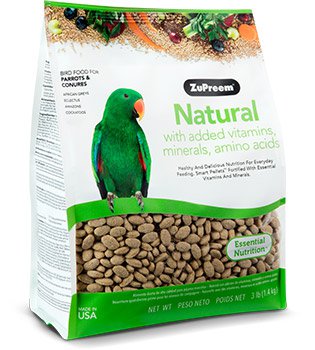
natural-ml.original

One of my biggest irritants is that people buy food because there’s a picture of their bird species on it.

I feed Zupreem too, one size smaller. Which is the cockatiel size. There is a whole less wastage when it is bitten to pieces. One thing I observed about my birds is that some of them – especially the males which have partners to feed – will swallow pieces of food whole. Sprouted green beans, shelled seed get shoveled down throats without being chewed. Eclectus are well-known for their greediness.

Solomon Island Eclectus are also smaller sized and do not have the same beak strength as their bigger subspecies counterparts. You cannot expect an SI to comfortably eat the same pellet size as an Aruensis.

The majority of Eclectus soak their food in water (making ‘soup’) to soften it before swallowing. Some will hold it in their feet and take small bites.

So when you pass by a soupy bowl be thankful.

I remember I had a Vosmaeri male youngster that I was due to pickup some years back. But the day before I was to collect him, he was reportedly dead. I wonder if it was the same case…

Fruits & vegetables. You might question then how come some folks don’t chop up their fresh food and wonder if it’s safe. The difference is that fruits and vegetables are softer than pellets.

Do I chop up my fresh food? Yes, because there’s less wastage xD

The next time you buy pellets or treats, do consider to get one size smaller. Save your wallet and potential heartache. And of course don’t wait til your bird is starving before feeding anything.

Please note that this doesn’t mean you buy toys one size smaller. Rather, get something larger when it comes to toys. Little wooden beads can be equally dangerous, especially to youngsters who have yet to learn to play with toys.

Categories: Eclectus Keeping | Leave a comment

Bringing Your Baby Home

Updated 12th May 2020


I’ll admit to neglecting this post for a while, always preferring to speak in person. But some folks need reminders or reassurance so I’ll just leave this here.

If you’re reading this, it is likely you’ve just purchased or about to buy a baby bird. It doesn’t matter from where, just as long as this post helps someone…

You will need – depending on the age of your bird:

  • Big plastic tank/ box

Preferably translucent and NOT round. Babies like to put themselves in corners (especially African Greys and lovebirds) and a round container does not give that security. A  fish tank works wonders because the lid prevents older chicks from clambering out.


  • Wood shavings/ metal mesh

Wood shavings can be bought cheaply (I prefer the $5 per large bag from Que Feng @ Serangoon North – also referred by most people as the ‘China shop’), get a bag that does not have too small pieces that might be ingested.

Or if you’re good with DIY, get a piece of metal mesh (stainless steel preferred) and bend it until it fits your tank/box. This is only for older birds that can balance better or birds that are starting to show problems of splay leg.

Some people opt to use wood shavings til the bird is old enough to be transferred to a cage, both mesh or without mesh is fine as long as hygiene is reasonably maintained.


  • Thermometer

I’m afraid those used for children won’t do. They are not as accurate because of the small metal tip and most do not measure up to 43’C. Use these instead –

20161024-thermometer-review-2

Digital or manual is fine. If you can find a manual one it will be better.


  • A few suitable perches

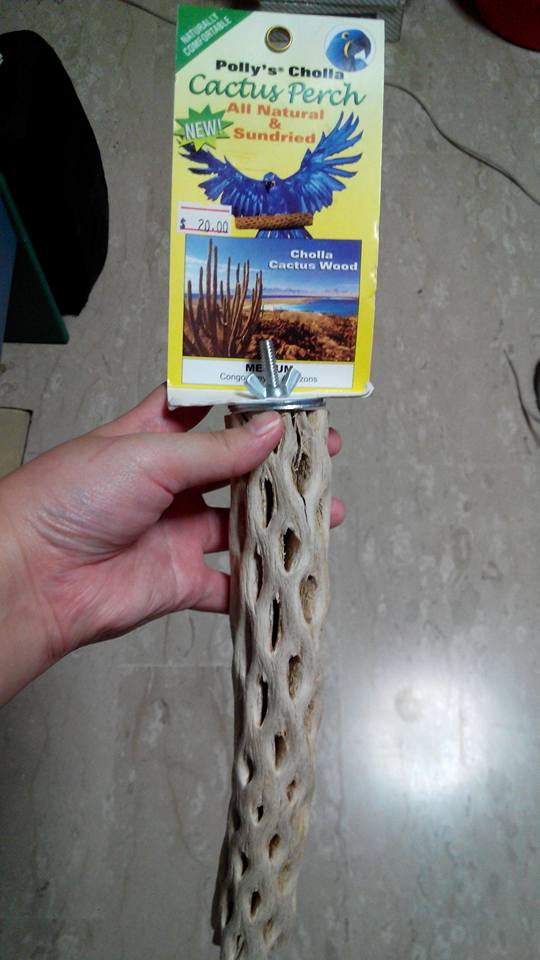
A perch of appropriate diameter for your bird size for it to learn how to perch over time. Get a few because it’s more than likely to be soiled along the way and require washing. I favour cactus perches because of the holes and grooves that allow for better grip for babies: (but it’s also a pain to wash!)

Cactusperch1

I got the above from Goodwill and unfortunately they do not always have it in stock. I would not recommend using sandy (UNSAFE! youngsters will chew on whatever they can!) or concrete/cement perches yet even if the baby’s nails are razor because the bird’s feet are still very soft and the claws are needed for better grip until it is almost fully feathered.

*Perches should not be installed until the bird is capable of walking and climbing (or trying to escape the box) without assistance.


  • Handfeeding formula

Please purchase and have a bag of formula at home first before bringing your bird back. Or buy it together with the bird if you’re getting from a shop. It is not good to move young birds too much especially when transferring to new environment, it’s stressful for them. And you don’t want to panic and find out that the nearest shop does not have the brand you need.

Take note that with the demise of Zupreem Embrace, the next best available handfeeding formula for Eclectus – in particular the Vosmaeri subspecies – is Psittacus High Protein. Unfortunately Psittacus is often out of stock due to supplier fault. In such a case I would unfortunately recommend Kaytee as the replacement. Some chicks develop funny colours on Kaytee which will molt out in time.


  • Feeding utensils

Stainless steel cups/ spoon for formula mixing and syringe or handfeeding spoon. I prefer stainless steel cups over porcelain because I can get a more accurate feel of the  formula temperature inside. This is ONLY for experienced handfeeders who can roughly gauge without using a thermometer. If using a syringe, I recommend a 12 or 20ml syringe depending on the size of your hand.


Now you’re all set to get your bird.


1.5 month female Eclectus learning to perch in her box & young male Eclectus in a box of shavings.

Categories: Eclectus Keeping | Leave a comment

Eclectus in SG Apartments

You’ve probably read about Eclectus on the Internet before you found my site. Are they suitable for Singapore homes?

Because 99% of us live in an apartment. So is an ekkie suitable to keep in our cramped space?

Presuming your bird has been raised properly (ie no forced weaning, appropriate feed and sleep schedules) these are the periods when it will be the loudest:

  1. 5-7 months old
  2. 1.2-1.5 years old
  3. Hormonal when mature
  4. First egg/babies
  5. Night frights

Weaning is arguably the loudest time of keeping an Eclectus. This period will pass over the course of 1-3 months. There is no cure for this as it is nature intended, but to have patience and earplugs. (If you cannot tolerate this then you should not get a large macaw as they also call frequently as babies. I have friends who had to rehome theirs!)

During weaning it is important not to accidentally let the bird slip into calling for attention! Resist the temptation to run to them whenever they cry and most importantly – set a schedule of when to handle and when not to so the bird understands resting and cage time!! A youngster I knew was so well loved that unfortunately he was loved into habitual screaming for attention and eventually given up. Many hearts were broken, please save yours.

Eclectus learn to talk best around 5 months old so they will be very chatty during that period. So if your bird hears some abominable sounds, it’s going to mimic that. My SI male picked up some Green-cheeked conures’ screaming in 2 days. The youngest I’ve seen talking is a purebred Vos female at 3 months old.

At 1.2-1.5 years of age hormones start to show up especially for females. This is worse if you have a pair living together, she will start chasing the male around and panicking – he screams while she growls.

When mature, both develop their thunderous crow-like screams. I have found in my experience that females do not scream randomly under a certain set of circumstances (ie have a nestbox) unless there are strangers or naturally if something excites them but for the males they tend to go off without a reason. Alpha males will scream if they see another male flapping or even nearby, when they are hormonal and unable to release frustration (females MAY scream also if they are nesty without a box).

I also observe that with the laying of their first clutch, regardless of whether there are babies eventually or not, females can get exceedingly noisy. It would take time for her to slowly settle down into her laying cycle.

Night frights. Youngsters are prone to falling off their perches, especially males whose grips seem to be weaker than females of equivalent age. Night fright in mature birds however, is likely to be accompanied by screaming.

Subspecies also matters when it comes to volume. The Aruensis are the loudest of all in volume. Between males and females, female Vos produce more frequent sounds. SI males are also very chatty after weaning.


Is there a set timing for screaming?

Eclectus are generally not screamer type birds, but they can start talking as the sun rises and evening. Morning can be controlled by a dark blanket over the cage or verbal/physical discouragement of sounds however I have found that evening time is harder to control. Might just as well no one sleeps at 5-6pm usually.


So what can be done to minimize noise?

Assuming your bird isn’t a habitual screamer by improper weaning or learned, you can make changes to prevent screaming as much as possible.

One is to make sure your bird has enough sleep and in complete darkness. My room windows are blacked out with layers of paper, foil and curtains. Every night it’s lights off at 9-9.30PM and I only open the windows at 1030AM. Air circulation is done with a good air purifier and ajar door.

Two, food is important. I observed that my birds tended to sleep restless on a non-full stomach. They take longer to sleep and wake earlier to call out for food. That doesn’t mean leaving food the whole night, just make sure dinner is sufficient. Also provide less mushy food for hormonal females. Less sugary foods should be given for dinner or the whole day if possible so no one has excess energy which to vocalize with.

Three, entertainment. Each of my cages has at least a wooden toy. Foraging toys don’t work for every bird, so keep that in mind. The birds also have their partners to occupy themselves with. Those not prone to screaming at the sight of crows get the window seat.


Habitual screamers. What to do?

If by unfortunate luck you landed a screamer, better find out the root cause of the screaming and pray it isn’t for attention. Birds that have been badly weaned can still be saved with extreme tolerance and frequent, overfeeding.

I bought a pair of 1.5 year olds whose owner informed me they called in the morning and evening. I covered them initially and slowly allowed more light in during the mornings and eventually both stopped their routine calls.

I also have a pair of Vos that my friend said were prone to screaming. I made sure they always had food and numerous toys along with additional perches and both have been quiet unless the female has eggs.

Attention seekers or contact calls. This you’d need to have extra patience. A Vos female for some reason became very attached to me – visually? – despite being untame and made frequent contact calls if I was not in sight. Initially I berated her as that is my usual with the others but decided to take a different approach since it wasn’t working and ignore her completely if it were in the day time. Over a few weeks she learned I was not going to respond and eventually quietened down to a more tolerable level.

Otherwise, more toys/favourable food works. Some birds just hate vegetables and will protest until given something else.

Take note that birds kept on a stand all the time also tend to be noisier due to the lack of entertainment. A toy hung from a hook is poor enrichment for the mind. There is also no security for the bird.

How long it usually takes for a screamer to stop? A month or so provided you have been consistent. If at any point you give in, the whole process must be restarted.


Human housing in general in Singapore:

If you live in a BTO or one of those DBSS executive flats, an Eclectus may not be suitable to keep. Unfortunately the newer flats tend to be built facing each other and very close, allowing for echoes to bounce back and forth. Also new flats have thinner walls.

If you still want to keep an Eclectus I recommend an older bird whose history you know with a big cage of toys or a Solomon Island male.

Categories: Eclectus Keeping | Leave a comment

Eclectus Cage Size

This is fairly standard. You would have come across any site that recommends a cage as big as possible or at least big enough for the bird to flap/extend its wings completely.

Except that we’re talking about Singapore. Tiny country with equally tiny land space and the majority of parrot keepers live in apartments. I do not like putting birds in small cages (or what Western countries would say micro!) but unless someone gives me 5 million US dollars to buy a landed house, I won’t be putting my flock into macaw cages.
_______________________________

Standard medium-size parrot cage: (I only have this picture, so it’s being overused haha. I also acquired the bird in the picture!)

IMG-20140317-WA0001

Just about everyone who buys a medium size parrot starts out with one of the above. That’s the cage that every medium size parrot is kept in too, in every bird shop here.

Now, that cage is big enough if the bird were allowed out most of the day. Unfortunately let’s face the fact, most of us have to work. So that cage is not big enough for anything larger than most conures.

I keep my birds in dog cages. Bite me if you will, haha. Because parrots don’t use the bottom half of tall cages. So I prefer the width and length given by dog cages. Mind you, dog cages are cheaper than ‘bird’ cages.

IMG_20140804_193430[1]

That’s a 3 feet (90cm) dog cage. The male is also the same bird in the smaller cage before this pic 🙂

Personally I feel that the minimum cage size for an eclectus is 2.5 feet (75cm) dog cage. 3 feet (90cm) is optimum. Enough for wing flapping, climbing around, lots of toys and perches. Not all birds like a big cage though. I had a pair continuously fight and chase each other until I switched to a 2.5 feet cage. And I’ve seen Amazons/Greys breed in tiny spaces and still be able to flap in that cage in the topmost photo.

Stainless steel cages are also very affordable nowadays. If you count that most are non-304 grade which means they DO rust (all SS cages rust unless they are marine grade 316) but generally they last longer than painted or powder coated ones.

Thanks, China. All the cheap stuff is coming from there.

Do be wary of too-good-to-be-true deals from sellers claiming to have 304 grade cages though. It’s very hard to determine if a cage is actually 304 or not unless it rusts quickly…

Marine grade 316 is incredibly, incredibly expensive.

Another thing about stainless steel cages is that they are super heavy! That is partly why I am reluctant to get one, to push it out to washing area or even changing the newspapers (tray is SS too!) is a real test of strength.

If you want to buy a SS cage, I recommend online sellers. Shops charge way higher but of course you get to view it physically.

Also beware of sellers listing *chrome* cages as stainless steel. The difference is in weight. Chrome is also a lot shinier.

Categories: Eclectus Keeping | Leave a comment

Create a free website or blog at WordPress.com.